
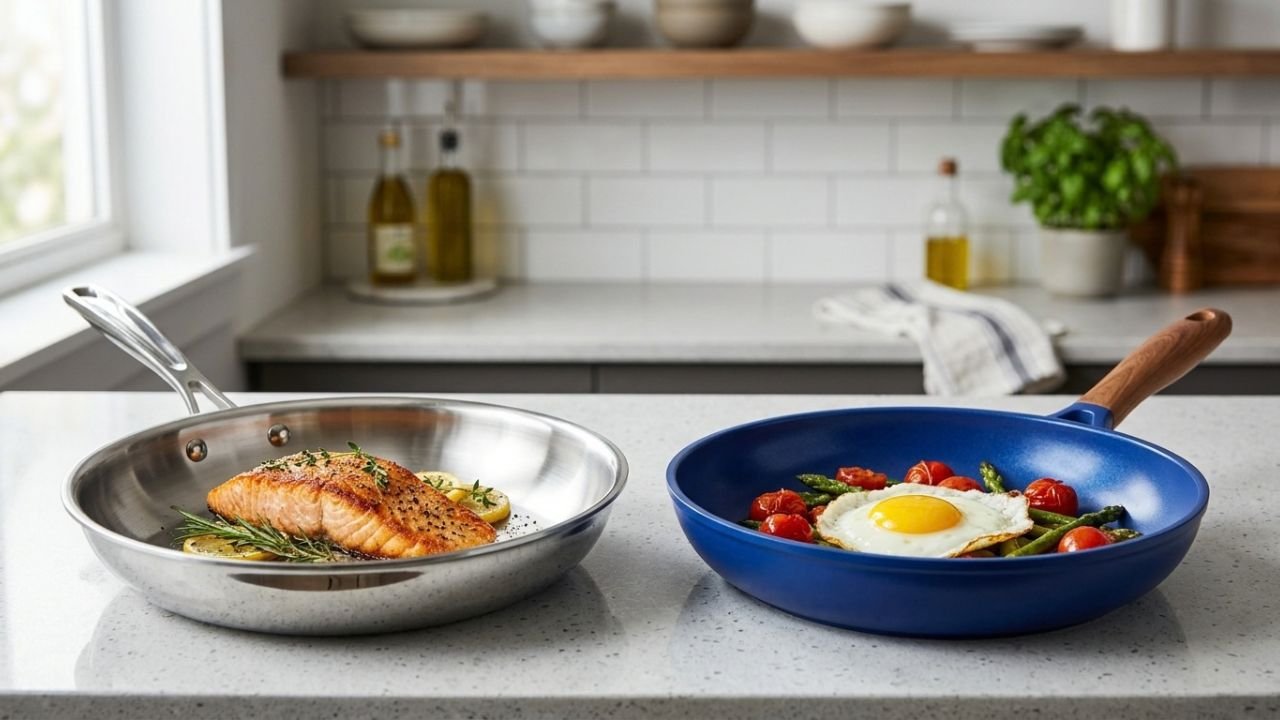
So you’re staring at a wall of pots and pans, and your brain just froze. Stainless steel? Ceramic? Which one do you actually need?
I’ve been there. Actually, I burned through three cheap nonstick pans in two years before I finally got serious about cookware. That’s when I learned something important: this isn’t about picking one “best” material. It’s about picking the right tool for how YOU cook.
Let me save you the trial and error.
The Real Difference in 30 Seconds
Here’s the quick version before we get into the details.
Ceramic cookware gives you a slick, nonstick surface that releases eggs like magic. It’s pretty, comes in fun colors, and feels effortless to cook with. But that magic fades. Most ceramic pans need replacing every 2-5 years .
Stainless steel cookware is the workhorse that lasts decades. It sears meat beautifully and builds flavor in ways nonstick can’t. But it demands technique. If you don’t preheat it right, your eggs will stick like they’re glued on.
Neither is “better” outright. They do different jobs .
What Is Ceramic Cookware, Really?
Quick reality check: that “ceramic” pan isn’t actually a clay pot. It’s a metal pan (usually aluminum) with a silicon-based coating on top . The coating creates that smooth, nonstick surface.
What ceramic does well:
-
Releases food easily with minimal oil
-
Heats up fast
-
Works great for eggs, pancakes, fish, and delicate stuff
-
Doesn’t react with acidic foods like tomato sauce
-
Comes in gorgeous colors that look great on your stove
Where ceramic struggles:
-
The nonstick coating wears out. Expect noticeable performance drops within a year of regular use
-
You can’t crank the heat. Medium is your ceiling
-
Metal utensils will scratch it. Stick with wood, silicone, or plastic
-
You need to hand-wash it to make it last
I learned this the hard way with my first ceramic pan. I treated it like my old stainless steel, used metal tongs, cranked the heat. Six months later, everything stuck. Whoops.
What About Stainless Steel?
Stainless steel cookware is an alloy made from steel mixed with chromium and nickel. Those metals make it resistant to rust, corrosion, and scratches . High-quality versions have a core of aluminum or copper sandwiched between layers of steel for better heat distribution .
Why cooks love stainless steel:
-
It lasts for decades. Seriously, you can pass these down
-
Takes screaming-hot heat for perfect searing
-
You can use metal utensils without fear
-
Creates “fond” (those browned bits) that become incredible pan sauces
-
Works with acidic ingredients without reacting
-
Dishwasher-safe (though hand-washing keeps it looking nicer)
The catch:
-
Food sticks if you don’t preheat properly
-
You need a bit of oil or butter for most cooking
-
Cleaning requires more elbow grease than ceramic
-
The learning curve is real
My stainless steel skillet felt impossible at first. Everything stuck. Then someone told me to preheat the dry pan until water droplets dance across the surface. Game changer.
Head-to-Head: The Categories That Matter
1. Food Release
Ceramic wins this one. Eggs slide right out. Fish doesn’t tear. Pancakes flip perfectly. That’s the whole point of a nonstick surface .
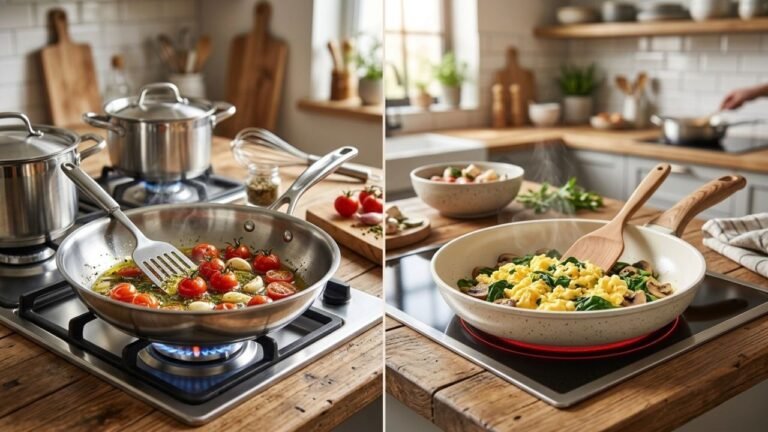
Stainless steel becomes “naturally nonstick” when you preheat it correctly, but it’s never as forgiving as ceramic .
2. Searing and Browning
Stainless steel wins, no contest. Nonstick surfaces can’t handle the high heat needed for a proper crust . That golden-brown exterior on a steak? You need stainless steel (or cast iron) for that.
Those browned bits stuck to the pan? That’s flavor. Add wine or broth, scrape them up, and you’ve got a pan sauce that ceramic could never produce .
3. Durability
Stainless steel, by a mile. A quality ceramic pan might last 3 years with perfect care . Stainless steel lasts decades—maybe forever .
Think about it this way: ceramic coatings are wear items. They degrade. Stainless steel has no coating to wear out .
4. Ease of Use
Ceramic is more beginner-friendly. Low heat, little oil, food comes out. Done.
Stainless steel punishes mistakes. Too low heat? Sticks. Too high heat? Sticks. Add food before the pan is ready? Sticks.
But once you learn the rhythm, stainless becomes intuitive .
5. Health and Safety
Both are considered safe options, especially compared to older nonstick technologies.
Stainless steel has no coating at all. Nothing to wear, flake, or leach. The main concern is nickel and chromium leaching when cooking acidic foods, but studies show amounts stay within safe limits for quality cookware .
Ceramic cookware made in the last several years is free from PFAS, PFOA, and PTFE. Those are the “forever chemicals” linked to health issues in older nonstick pans .
The key word is quality. Cheap ceramic with questionable coatings isn’t the same as reputable brands with published safety testing .
6. Maintenance and Cleaning
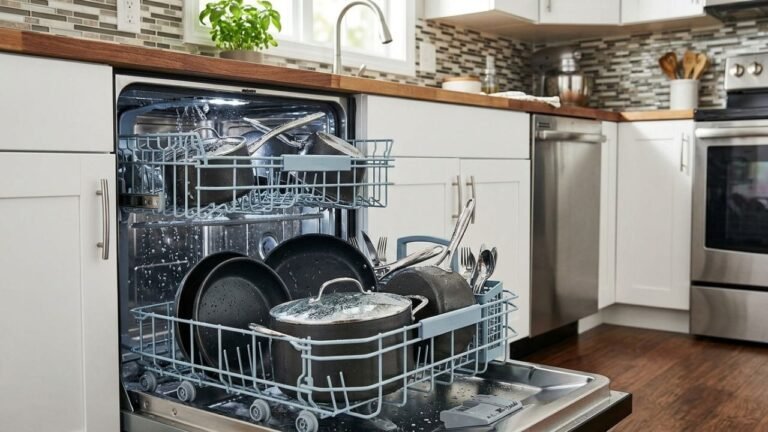
Ceramic cleans up in seconds. Wipe with a sponge, rinse, done. But you can’t throw it in the dishwasher without shortening its life .
Stainless steel requires more scrubbing, especially if food stuck. But it’s dishwasher-safe, and you can use abrasive cleaners without worrying about destroying a coating .
7. Cost Over Time
This one surprises people.
A $40 ceramic pan that lasts 18 months costs about $27 per year. A $120 stainless steel pan that lasts 15 years costs $8 per year .
Stainless steel is cheaper in the long run. Ceramic keeps you coming back to the store .
Stainless Steel vs Ceramic Cookware Comparison Table
| Feature | Stainless Steel | Ceramic |
|---|---|---|
| Nonstick Ability | Needs technique; improves with use | Excellent when new |
| Durability | Excellent, lasts decades | Good for a few years |
| High Heat Tolerance | Excellent | Limited (usually under 450°F) |
| Ease of Cleaning | Moderate | Very easy when coating is intact |
| Weight | Heavier | Lighter |
| Metal Utensils | Yes | No |
| Oven Safe | Usually high temps | Often limited |
| Best For | Searing, sauces, everyday heavy use | Eggs, fish, low-oil cooking |
| Lifespan | Very long | Shorter |
| Price Over Time | Higher upfront, better value long-term | Lower upfront, more frequent replacement |
Which One Should YOU Buy?
Ask yourself these questions:
Do you cook eggs, pancakes, or fish several times a week?
Get ceramic.
Do you sear steaks, make pan sauces, or roast in the oven?
Get stainless steel.
Want one pan that does everything?
You can’t have that. Sorry. Buy one of each .
Cooking for one or two people with simple meals?
A ceramic skillet and a stainless saucepan cover most needs.
Serious home cook who wants buy-it-for-life quality?
Invest in stainless steel. Add a ceramic pan for eggs .
Honestly? The answer for most kitchens is both. They complement each other. Ceramic handles the delicate stuff. Stainless handles the heavy lifting.
My Personal Take
After years of cycling through cookware, here’s where I landed.
I keep a ceramic nonstick pan for eggs and quick breakfasts. It’s my “lazy morning” pan. Low effort, easy cleanup.
Everything else happens in stainless steel. Searing chicken thighs. Building pan sauces. Roasting vegetables in the oven. I don’t worry about scratching it or accidentally leaving it on high heat.
That stainless skillet has outlasted three ceramic pans. It still looks great. It still performs perfectly.
Quick Tips for Making Either Last Longer
For ceramic:
-
Never preheat empty on high heat
-
Use wood, silicone, or plastic utensils only
-
Hand-wash with soft sponges
-
Let it cool before washing (no thermal shock)
For stainless steel:
-
Preheat before adding food. Water droplet test: if it beads and dances, you’re ready
-
Let the pan cool slightly before deglazing
-
Barkeeper’s Friend removes stains beautifully
Frequently Asked Questions
Is ceramic cookware safe?
Yes, modern quality ceramic is free from PFAS, PFOA, and PTFE. The coating is made from silicon-based materials, not synthetic chemicals .
Does stainless steel leach metals into food?
Trace amounts of nickel and chromium can leach, especially with acidic foods. Studies show amounts stay within safe limits for quality cookware, but people with nickel sensitivity might want to avoid it .
Can I use metal utensils on stainless steel?
Absolutely. That’s one of its biggest advantages over ceramic .
Why does everything stick to my stainless steel pan?
You’re not preheating enough. Heat the empty pan over medium for 2-3 minutes. Test with a water droplet. Add oil. Then add food .
Which lasts longer?
Stainless steel lasts 20+ years. Ceramic typically needs replacement every 2-5 years .
Can I put ceramic cookware in the oven?
Check your specific brand. Many ceramic pans are oven-safe to 400-450°F, but some handles aren’t oven-safe at all .
The Bottom Line
Stop looking for the “best” cookware. Start thinking about the right cookware for each job.
Ceramic excels at easy-release cooking. It’s forgiving, pretty, and perfect for eggs and delicate foods. But it’s a consumable. You’ll replace it.
Stainless steel demands technique but rewards you with decades of service and the ability to create restaurant-quality sears and sauces. It’s an investment that pays off.
My honest recommendation? Get a stainless steel skillet as your foundation. Add a ceramic nonstick pan for eggs and lazy mornings. Together, they cover almost everything you’ll ever cook.
Your future self will thank you.