
You’re standing in the kitchen aisle (or scrolling late at night), staring at two shiny All-Clad options. One says D3. The other says D5. Both cost real money. Both claim to be pro-level. And you’re wondering which one actually belongs in your kitchen.
I’ve been there. More than once. I’ve cooked with both lines for years—searing steaks, babying sauces, burning the occasional batch of onions because I got distracted. Here’s the straight talk from someone who’s lived with these pans day in and day out.
The short version first.
All-Clad D3 (3-ply) heats faster, feels lighter, and costs less. All-Clad D5 (5-ply) heats more evenly, holds temperature better, and feels more substantial. Neither is “better.” They just suit different cooking styles and budgets.
Let’s break it all down so you can decide without the marketing fog.
Deep Discounted Deals for All-Clad 3 Ply & 5 Ply (up-to 33% OFF)
All-Clad D3® Stainless Steel Cookware Set, 7-Piece (33% OFF) Limited Time Deal
All-Clad D5® Stainless Steel 10-Piece Cooking Set (20% OFF) Limited Time Deal
What “3-Ply” and “5-Ply” Actually Mean
All-Clad bonds layers of metal together so the heat moves through the whole pan, not just the bottom. That’s the whole point of “clad” cookware.
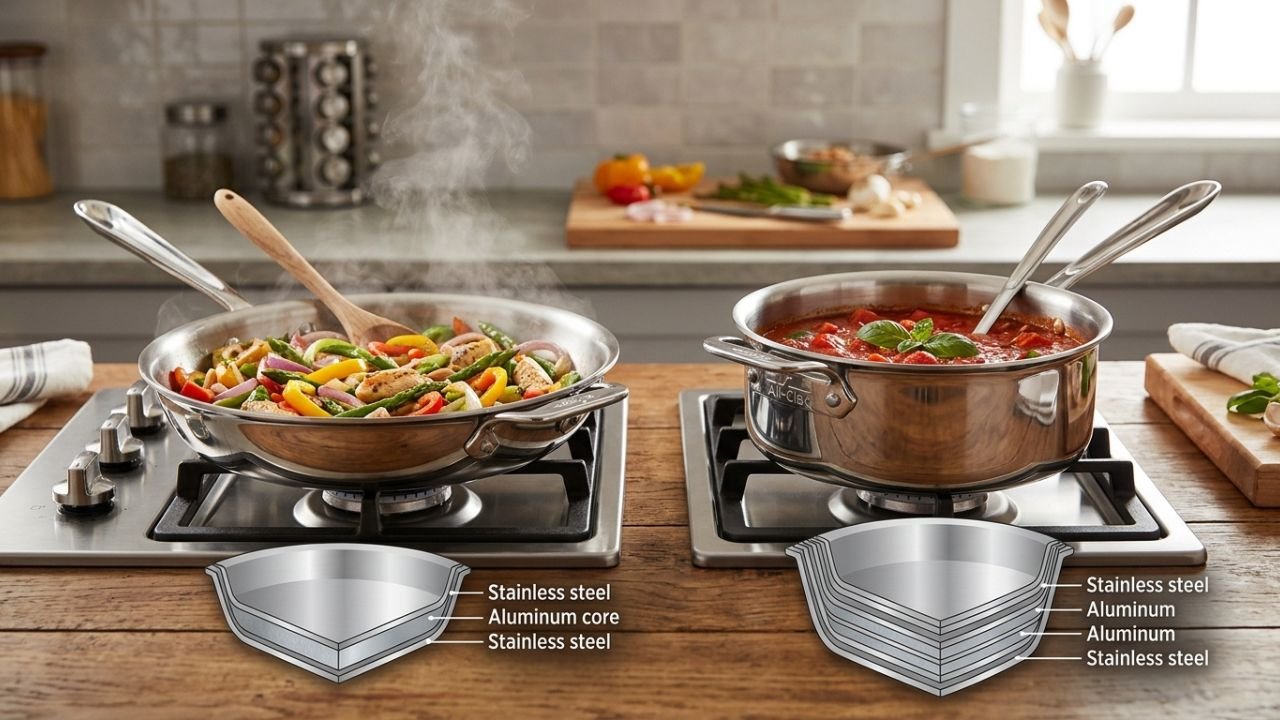
D3 construction looks like this:
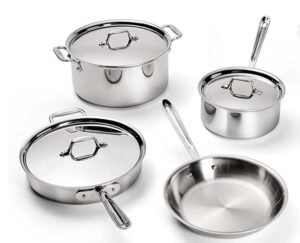
- 18/10 stainless steel cooking surface
- Thick aluminum core
- Magnetic stainless steel exterior
Three layers total. Simple. Effective. The aluminum core moves heat quickly. The stainless keeps it durable and induction-ready.
D5 construction adds two more layers:
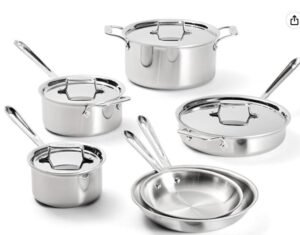
- Stainless cooking surface
- Aluminum
- Thin stainless steel core
- Another aluminum layer
- Stainless exterior
Five alternating layers. The extra stainless in the middle acts like a bit of a speed bump for heat. It slows things down just enough to spread the heat more evenly and hold temperature longer.
Both lines measure about the same overall thickness (around 3 mm). The difference isn’t bulk—it’s how the layers are stacked and what that does to heat behavior.
Ever notice how some pans scream “hot!” the second you turn the burner up, while others take their sweet time? That’s the ply difference in action.
Heat Performance: Speed vs Stability
This is where the real personality shows up.
I ran side-by-side tests with a surface thermometer more times than I care to admit. On medium-high heat:
- The D3 skillet hit higher temps faster. After one minute it was noticeably hotter in the center.
- The D5 lagged a bit at first but caught up and stayed more even from center to edge.
Turn the heat down or take the pan off the burner and the D5 holds its temperature longer. The D3 cools quicker. That’s not a flaw—it’s a feature depending on what you’re cooking.
When D3 shines:
- Searing a steak and wanting to drop the heat fast for a pan sauce
- Sautéing vegetables that can go from perfect to mush in 30 seconds
- Quick weeknight cooking where you adjust the flame a lot
When D5 shines:
- Simmering a tomato sauce for an hour without babysitting
- Making custards, hollandaise, or anything that hates hot spots
- Cooking on induction or electric ranges that already have uneven heat
I once made a big batch of caramelized onions in both. The D3 needed more stirring near the edges. The D5 just… did its thing more evenly. Small difference, but noticeable if you cook a lot of delicate stuff.
Weight, Feel, and Everyday Handling
Pick up a 12-inch skillet from each line and you’ll feel it immediately.
D3 sits lighter. Tossing food feels natural. Pouring from a full pan doesn’t make your wrist complain as much. D5 feels more planted and solid. Some people love that “this is serious cookware” heft. Others find it tiring after a long cooking session.
Handles differ too. D5 often comes with slightly longer or more substantial handles. The classic D3 handle works fine for most hands, but some folks prefer the D5 grip.
Finish is another quiet difference. Classic D3 comes polished and shiny. It looks sharp new, but every water spot and scratch shows. D5 frequently offers a brushed finish that hides daily wear better. That matte look stays nicer longer if you’re not obsessive about polishing.
Price Reality Check
D5 costs more. Usually 20–30% more for comparable pieces or sets. You’re paying for the extra layers, the slightly different heat profile, and often the brushed option.
Is the jump worth it? For a lot of home cooks, no. D3 already performs at a professional level. The extra money buys refinement, not a night-and-day upgrade. If budget is tight or you’re outfitting a whole kitchen, D3 gives you more pan for the dollar.
That said, if you cook a lot of slow, steady dishes or just prefer the feel and finish of D5, the premium can make sense. I’ve seen people buy one D5 skillet they use constantly and fill the rest of the kitchen with D3. Hybrid setups work great.
Durability, Care, and Longevity
Both lines are built in Canonsburg, Pennsylvania. Both carry All-Clad’s limited lifetime warranty. Both handle oven and broiler temps up to 600°F (lids lower). Both work on induction, gas, electric, the works.
Warping resistance edges toward D5 because of the extra layers, but both hold up extremely well if you don’t thermal-shock them (no ice-cold water into a screaming-hot pan).
Cleaning is the same story for both. Stainless steel can stick if you don’t preheat properly or use enough fat. A good soak and some Bar Keepers Friend usually brings them back. Dishwasher-safe according to the company, but most of us who care about our pans still hand-wash. The brushed D5 finishes hide the inevitable scratches better over years of use.
I’ve had D3 pieces for over a decade that still look and cook great. Same with D5. Treat them right and either line becomes heirloom stuff.
Pros and Cons Side by Side
All-Clad D3 (3-Ply) Pros:
- Faster heat response and better temperature control when you need it
- Lighter weight for easier handling and tossing
- Lower price for nearly the same core performance
- Classic polished look many people love
- Excellent for searing, sautéing, and everyday cooking
All-Clad D3 Cons:
- Can develop more noticeable hot spots if you crank the heat carelessly
- Polished finish shows scratches and water spots
- Slightly less heat retention for long, low simmers
All-Clad D5 (5-Ply) Pros:
- More even heat distribution and fewer hot spots
- Better heat retention and stability
- Often available in brushed finish that hides wear
- Slightly more warp-resistant feel
- Feels substantial and “pro” in the hand
All-Clad D5 Cons:
- Heavier, which some people dislike over long sessions
- Higher price tag
- Slower to respond when you need quick temperature changes
- Can feel like overkill for simple weeknight cooking
Who Should Buy Which?
Ask yourself a few honest questions.
Do you cook mostly quick, high-heat dishes and like to stay in control of the flame? Go D3.
Do you make a lot of sauces, braises, or delicate things and want the pan to be more forgiving? D5 starts looking better.
Are you buying your first serious stainless set and watching the budget? D3 almost always wins.
Do you already own some All-Clad and just want one special piece? Grab the D5 skillet or sauté pan and see how you like the difference.
Most home cooks land on D3 and never look back. The performance gap is real but smaller than the marketing sometimes suggests. I’ve cooked restaurant-style meals on D3 for years without feeling limited.
Real Kitchen Scenarios
Let me walk through a few common situations.
Steak night. Preheat the pan properly. D3 gets screaming hot faster and gives you that aggressive sear. D5 still sears beautifully but takes a touch longer to get there and holds the heat longer once the steak is in.
Weeknight stir-fry or sauté. D3 feels livelier. You can toss ingredients and adjust heat on the fly without the pan lagging behind.
Sunday sauce or risotto. D5’s steadiness shines. Less risk of scorching on the edges while the center simmers gently.
Induction cooktop. Both work, but D5’s evenness can help smooth out any quirks some induction zones have.
I keep both a D3 skillet and a D5 saucepan in regular rotation. Different tools for different jobs. That’s a perfectly valid approach if you don’t want to choose just one line.
All-Clad 3 Ply vs 5 Ply Comparison Table
| Feature | All-Clad D3 (3-Ply) | All-Clad D5 (5-Ply) |
|---|---|---|
| Construction | Stainless / Aluminum / Stainless | Stainless / Al / Stainless / Al / Stainless |
| Heat Response | Faster, more responsive | Slower, more stable |
| Heat Evenness | Very good | Excellent |
| Weight (approx. 12″ pan) | Lighter (~2.8–3 lbs) | Heavier (~3.1–3.2+ lbs) |
| Exterior Finish | Polished | Brushed or polished |
| Price Level | Lower | Higher |
| Best For | Everyday cooking, searing, control | Steady heat, sauces, braising |
| Induction Compatible | Yes | Yes |
| Oven Safe | Up to 600°F | Up to 600°F |
| Made In | USA | USA |
FAQs
Is 5-ply always better than 3-ply?
No. More layers don’t automatically equal better cooking. It depends on the materials, thickness, and what kind of cooking you do. D3’s aluminum core is thick and effective. D5 trades some speed for stability.
Will I notice the difference in daily cooking?
Sometimes yes, sometimes no. On high heat searing or quick adjustments, D3 feels snappier. On long simmers, D5 feels more relaxed. For a lot of normal home cooking the difference is subtle.
Which one do professional chefs use more?
Plenty of pros still reach for classic tri-ply (D3-style) because responsiveness matters in a busy kitchen. Both lines show up in restaurants, though.
Can I mix D3 and D5 pieces?
Absolutely. Lids often interchange within similar sizes, and the cooking performance difference won’t ruin your life.
How do I care for either line?
Preheat properly. Use enough oil or fat. Don’t thermal shock them. Hand-wash when you can. Bar Keepers Friend is your friend for restoring the shine or removing stuck-on bits. Avoid abrasive pads that scratch the polished surfaces more than necessary.
Is the brushed finish on D5 worth it?
If you hate polishing and water spots, yes. It looks cleaner longer with normal kitchen abuse.
Final Thoughts
Choosing between All-Clad 3-ply and 5-ply isn’t about picking the “winner.” It’s about matching the tool to how you actually cook.
If you want lively, responsive pans that won’t break the bank as hard, D3 is the smart everyday choice for most people. If you crave that extra evenness and don’t mind paying and lifting a bit more, D5 delivers a more forgiving cooking experience.
I’ve cooked hundreds of meals on both. Neither has ever let me down when I treated it right. The real upgrade isn’t the number of plies—it’s finally owning cookware that conducts heat properly and lasts for decades.
So take a look at your most common recipes. Think about how much you move pans around. Check your budget. Then pick the one that fits your kitchen, not the one that sounds fancier on paper.
You’ve got this. Now go make something delicious. 🙂