
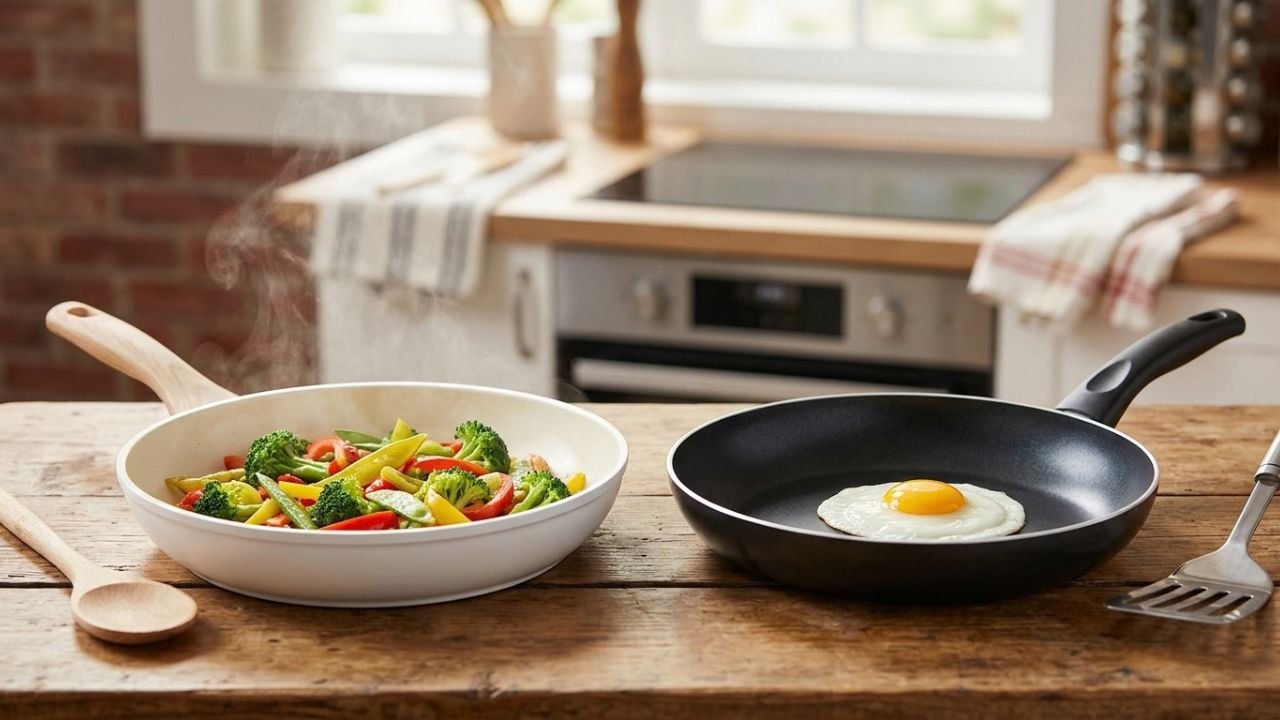
Ever stood in the cookware aisle staring at two pans that both claim to be non-stick and wondered what the heck the difference even is? Yeah, me too.
One says “ceramic.” The other says “Teflon” or just “non-stick.” The marketing makes them sound like total opposites. But are they? Or is one just a fancier name for the same old thing?
I cook almost every day. Eggs, pancakes, stir-fries, the works. I’ve burned through more non-stick pans than I care to admit. So when people ask me whether ceramic is the same as Teflon, I usually laugh a little and say, “Not even close.”
Let’s talk about it like we’re hanging out in the kitchen with coffee. No sales pitch. Just the real differences, the good, the bad, and the stuff the labels don’t tell you.
Ceramic Cookware vs Teflon: Quick Overview
| Feature | Ceramic Cookware | Teflon (PTFE) Cookware |
|---|---|---|
| Coating Material | Silica-based (sol-gel) | PTFE polymer |
| PFAS / PTFE | Free | Contains PTFE (a PFAS) |
| Max Safe Heat | Often 800°F+ | About 500°F |
| Toxic Fumes Risk | Very low even when overheated | Yes, if overheated above 500°F |
| Non-Stick Lifespan | Usually 1–3 years | Often 3–5 years with care |
| Scratch/Chip Risk | More brittle, can chip | Softer, scratches more easily |
| Best For | Higher heat, PFAS avoidance | Everyday low-medium heat cooking |
| Oven Use | Usually better | Limited, check label |
What Exactly Is Teflon Cookware?
Teflon is a brand name. The actual material is PTFE — polytetrafluoroethylene. It’s a synthetic polymer that makes food slide right off. DuPont invented it decades ago, and the name stuck.
Modern Teflon pans no longer use PFOA in manufacturing. That chemical got phased out years ago. What you buy today is PFOA-free. But PTFE itself still belongs to the bigger family of chemicals called PFAS, the ones people call “forever chemicals.”
Here’s the thing I learned the hard way. Teflon works ridiculously well when it’s new. Eggs practically jump out of the pan. Cleanup takes about ten seconds. But it has a hard limit. Heat it past about 500°F (260°C) and the coating starts breaking down. It can release fumes that make you feel like you caught the flu for a day or two. Birds are especially sensitive to those fumes, by the way.
IMO, most home cooks never hit that temperature on purpose. But leave an empty pan on high heat for a few minutes and you’re there before you know it.
What Is Ceramic Cookware, Really?
Ceramic cookware isn’t made of the same stuff as your coffee mug. Most “ceramic” pans are metal (usually aluminum) with a special coating applied on top. That coating is typically a silica-based material made through something called a sol-gel process. Think sand and minerals turned into a smooth, glass-like layer.
The big selling point? It’s free of PTFE and PFAS. No forever chemicals in the coating itself. Manufacturers love to slap “toxin-free” and “PFOA-free” all over the box, which is technically true for genuine ceramic coatings.
I switched to a ceramic pan a couple years ago after my last Teflon one started flaking. At first I was impressed. The surface felt hard and smooth. Eggs still slid around fine. And I didn’t have that nagging worry about overheating.
But here’s the catch nobody mentions loud enough. That slickness doesn’t last as long.
Ceramic vs Teflon: The Real Differences That Matter
Let’s break this down without the marketing fluff.
Non-Stick Performance
Teflon wins this one, hands down, at least in the beginning and for a longer stretch.
Fresh out of the box, both do a great job. But Teflon keeps that easy-release feeling longer. Ceramic starts strong and then slowly gets stickier over time. I’ve had ceramic pans that needed more oil after six or eight months of regular use. My better Teflon pans held up for years with the same care.
You ever notice how some ceramic pans start needing a little extra butter or oil after a while? That’s normal. The coating isn’t as durable in the long run for pure non-stick power.
Heat Resistance
This is where ceramic pulls ahead.
Most ceramic coatings can handle much higher temperatures — often up to 800°F or more — without breaking down or releasing anything nasty. Teflon starts having problems around 500°F.
If you like searing a steak or finishing something in a hot oven, ceramic gives you more breathing room. Just don’t get cocky. High heat still wears any non-stick coating down faster, ceramic included.
Durability and Lifespan
This one surprises a lot of people.
Teflon coatings are softer but more flexible. With decent care they often last 3 to 5 years. Ceramic coatings are harder but more brittle. They can chip or develop micro-cracks, and the non-stick effect usually fades sooner — often in 1 to 3 years.
I’ve had both. My longest-lasting Teflon pan went almost four years before the surface got rough. My first ceramic one started sticking after about 14 months of daily eggs and weekend pancakes. I treated them both the same way — wooden and silicone utensils only, hand washed, no metal, no dishwasher.
Quality matters a lot here. Cheap ceramic pans die fast. Higher-end ones with reinforced coatings last longer. Same goes for Teflon.
Safety and Health Concerns
This is the question everyone really cares about.
Ceramic is PFAS-free and doesn’t release toxic fumes when it gets too hot. That alone makes a lot of people feel better.
Teflon (PTFE) is safe when used correctly — under 500°F and with an intact coating. The American Cancer Society and other groups have said there’s no proven risk from normal use of modern PTFE pans. The problems show up when the pan is overheated or the coating is badly scratched and flaking.
Still, if the idea of any PFAS in your kitchen bothers you, ceramic is the clearer choice. Just buy from a brand that actually tests and labels their products as PTFE-free and PFAS-free. Some shady “ceramic” pans aren’t pure.
I keep birds out of my kitchen these days just to be safe. Once you read about polymer fume fever, you get a little paranoid.
Cleaning and Care
Both hate the same things:
- Metal utensils
- Dishwashers (even if the label says they’re safe)
- Abrasive scrubbers
- Cooking sprays that leave a sticky residue
- Extreme temperature swings (hot pan under cold water)
Hand wash with a soft sponge and mild soap. Dry them well. Store carefully so nothing scratches the surface.
Ceramic can stain more easily over time, especially with tomato sauces or turmeric. Teflon usually stays looking cleaner longer.
My Personal Take After Years of Both
I’ve used both sides of this debate.
For everyday low-to-medium heat cooking — eggs, fish, grilled cheese, pancakes — a good Teflon pan still feels more reliable and lasts longer. I don’t baby it, but I also don’t abuse it.
When I want higher heat or just want zero PFAS worries, I reach for ceramic. It works. It’s just not quite as magical for as long.
Neither one is a forever pan. Non-stick coatings are temporary by nature. That’s why I also keep a cast iron skillet and a stainless steel pan around for the jobs that need real heat or longevity.
You know what bugs me? The way some brands act like ceramic is completely indestructible and pure as driven snow. It’s not. And the way other brands still act like Teflon has zero concerns if you just “use it properly.” Both need honesty.
Who Should Buy Ceramic Cookware?
Go ceramic if:
- You want to avoid PFAS completely
- You cook at higher temperatures sometimes
- You prefer the idea of a more “natural” coating
- You’re okay replacing the pan a bit sooner
It’s a solid choice for health-conscious cooks who don’t mind a shorter lifespan.
Who Should Stick With Teflon?
Teflon still makes sense if:
- You want the best non-stick performance for the money
- You mostly cook on medium or low heat
- You take decent care of your pans
- You want something that lasts longer before the stickiness returns
Just stay under that 500°F mark and replace it when the coating looks rough or starts flaking.
Common Myths That Need to Die
Myth 1: Ceramic is completely natural.
Nope. The coating is still manufactured in a factory using chemical processes. It’s just different chemistry.
Myth 2: All Teflon is toxic.
Modern PFOA-free PTFE used at normal cooking temperatures is considered safe by major health organizations. The risk is mainly from overheating or damaged coatings.
Myth 3: Ceramic lasts forever.
I wish. Most don’t. Some lose their non-stick power surprisingly fast.
Myth 4: You can use metal utensils on either.
Please don’t. You’ll regret it.
How to Make Either Type Last Longer
A few simple habits make a huge difference:
- Always use low to medium heat
- Never preheat an empty pan on high
- Stick to wood, silicone, or plastic utensils
- Hand wash only
- Avoid cooking sprays
- Don’t stack pans without protection
- Replace them when the coating looks worn or food starts sticking badly
Treat them like temporary tools, not heirlooms, and you’ll get better results.
The Bottom Line
Ceramic and Teflon are not the same.
Teflon (PTFE) gives you superior long-term non-stick performance and is safe when used correctly, but it belongs to the PFAS family and has a lower heat limit.
Ceramic offers a PFAS-free coating, higher heat tolerance, and no toxic fumes if you overheat it, but the non-stick quality usually fades faster and the surface can be more fragile.
There’s no perfect winner. It depends on what you care about most — pure performance and longevity, or peace of mind about chemicals and heat.
I keep both in my kitchen. Different jobs, different pans. And when either one starts acting up, I replace it without guilt. Non-stick cookware was never meant to last a lifetime.
What about you? Are you team ceramic, team Teflon, or already looking at cast iron and stainless? Drop a comment if you’ve had a pan that surprised you — good or bad. I’m always curious what actually lasts in real kitchens.
FAQs
Is ceramic cookware safer than Teflon?
For most people concerned about PFAS and overheating, yes. Ceramic doesn’t contain PTFE and won’t release the same fumes if it gets too hot. Modern Teflon is still considered safe under normal use.
Does ceramic cookware contain Teflon?
Genuine ceramic coatings do not. Some cheap pans market themselves as ceramic while still using PTFE, so check the label carefully for “PTFE-free” and “PFAS-free.”
Why does my ceramic pan start sticking after a while?
The coating wears down. High heat, metal utensils, dishwashers, and cooking sprays speed that up. It’s normal, just happens sooner than with good Teflon.
Can I put ceramic or Teflon pans in the dishwasher?
You can, but you shouldn’t if you want them to last. Hand washing is kinder to both coatings.
What’s the safest non-stick option overall?
If non-stick is a must, high-quality ceramic gives more peace of mind on the chemical side. For pure durability of the non-stick surface, well-cared-for modern Teflon still performs longer. Many people eventually move toward uncoated options like stainless steel or well-seasoned cast iron for everyday cooking.
That’s the real difference, no hype required. Choose what fits how you actually cook, take care of it, and replace it when it’s done. Your eggs (and your lungs) will thank you. 🙂