
Okay, let’s be real for a second. If you’re reading this, you’re probably staring at your current non-stick pan and wondering why your scrambled eggs suddenly taste like regret. You know the drill—the Teflon is peeling, or it’s just lost its mojo, and everything sticks like glue.
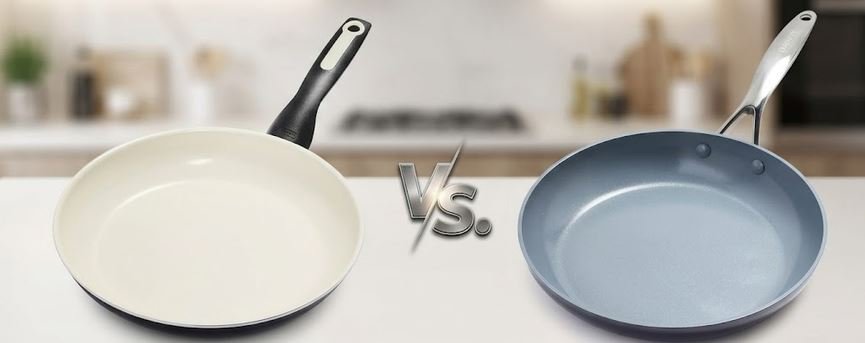
Maybe you’ve heard the good word about GreenPan. You know, ceramic, non-toxic, no PFAS, all that good stuff? But then you go to their site, or Amazon, or wherever, and you’re hit with this confusing lineup. The GreenPan Rio is staring at you with its cute colors, and the Valencia Pro is sitting right next to it looking sleek and charging a bit more. So which one is worth your hard-earned cash? You want to know if the extra dough for the Valencia Pro actually buys you better performance, or if the Rio is the hidden gem.
I’ve been down that rabbit hole, and I’ve cooked on both. FYI, I’m not here to sell you on the most expensive set just because it costs more. I want to break down the real differences—the good, the bad, and the sticky (literally, as you’ll see). Grab a coffee, and let’s chat about these pans like we’re old friends arguing over who makes the better pancake.
If You’re in Hurry We Have Low Price Offers for Both These Pans.
GreenPan Rio: Low Price Offer on Amazon
Valencia Pro: Low Price Offer on Amazon
What’s the Deal with GreenPan Anyway?
Before we get into the nitty-gritty, let’s level set. GreenPan is basically the poster child for the ceramic non-stick movement. They’re the ones who said, “Hey, maybe we shouldn’t be cooking our food on chemicals that might give us superpowers (but the bad kind).” Their claim to fame is that Thermolon coating. It’s made from sand, essentially, so it’s free of PFAS, PFOA, lead, and all those other letters that sound scary .
Here’s the cool part: their ceramic coating won’t release toxic fumes if you accidentally overheat it (because who hasn’t gotten distracted by a TikTok and let a pan get ripping hot?) . That’s a huge win in my book. It’s durable, eco-friendly, and generally a solid way to go if you’re trying to ditch traditional non-stick.
Now, within the GreenPan universe, you have tiers. The Rio and Valencia Pro are two of the most popular. They’re like the Honda Civic and the slightly-sportier Honda Accord of the cookware world. Same basic idea, but one has a few more bells and whistles.
Let’s Talk Hardware: Rio vs Valencia Pro Build Quality
When you hold these pans, the first difference you notice is the weight. And I don’t mean just in your hand; I mean the whole vibe of the pan.
The Body: Forged Aluminum vs. Hard Anodized
This is the biggest technical difference, so let’s break it down without getting too nerdy.
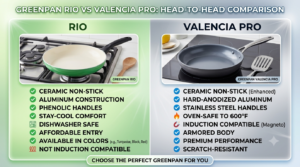
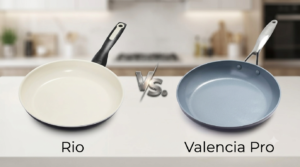
GreenPan Rio: This pan uses heavy-gauge forged aluminum . Think of it as the dependable workhorse. It’s lighter in the hand, which is great if you don’t want to feel like you’re lifting weights just to make an omelet. It heats up quickly and conducts heat well enough for most daily cooking.
GreenPan Valencia Pro: This one steps it up with a hard anodized aluminum body . Anodizing is a process that hardens the aluminum, making it more durable and scratch-resistant. It’s also got a thicker base—some tests show a 4mm base versus Rio’s 3.8mm . This means it’s less likely to warp over time, and it distributes heat more evenly. If you’re on an induction cooktop, you really want that thick, flat bottom.
The Coating: Diamond-Infused vs. Standard Thermolon
This is where the marketing gets flashy.
GreenPan Rio: It uses a Thermolon ceramic coating that’s reinforced with diamonds . Yes, actual tiny diamonds! The idea is to make it more durable and resistant to scratches. It’s a great coating, don’t get me wrong. It’s PFAS-free and does a fantastic job at releasing food for the first few months .
GreenPan Valencia Pro: This also uses a diamond-infused Thermolon coating, but it’s the next-gen stuff (sometimes called Thermolon 9G) . The coating is thicker—around 25 microns compared to Rio’s 22 microns—and feels slicker out of the box . It’s supposed to be more resistant to scratching and metal utensils (though I still wouldn’t test that theory with a fork). It’s basically the “premium” version of what’s on the Rio.
The Handles and Induction Compatibility
-
Rio Handles: You get a stay-cool Bakelite handle. It’s comfortable, doesn’t get hot, and is easy to grip . Super practical. Some reviewers note the handle is rivet-free on the inside, which means no gunk gets trapped under rivets .
-
Valencia Pro Handles: Here, you’re getting a mirror-polished stainless steel handle that’s also designed to stay cool thanks to a V-shaped cutout. It feels more premium and looks much nicer hanging on a pot rack . It feels like a “grown-up” pan.
-
Induction: Both work on induction, but the Valencia Pro’s “Magneto” base is specifically designed for superior performance on induction cooktops . It’s engineered to heat faster and more evenly on those finicky glass tops.
Performance in the Kitchen: The Moment of Truth
So, they look different, but how do they actually cook? I’ve used both extensively, and here’s my honest take.
Heat Distribution and Even Cooking
The Valencia Pro wins this round, hands down. Because of that thicker, hard anodized base, it heats up incredibly evenly. No hot spots, no burning your garlic while your onions are still crunchy. It’s a dream for searing fish or making perfectly golden pancakes . One reviewer even called it the best fry pan they’ve owned in 40 years !
The Rio is no slouch, though. It heats up quickly, which is perfect for a quick Tuesday night stir-fry. But you might notice a bit of edge-cooling if you’re cooking a lot at once . It’s not a dealbreaker by any means, but if you’re a precision cook, you’ll appreciate the Valencia Pro’s consistency.
The Dreaded Non-Stick Question
Here’s the thing about ceramic non-stick: it’s not Teflon. It doesn’t have that same “slidey egg” vibe right out of the box. It’s more of a “release” than a “slide.”
-
Rio: People generally love it at first. One reviewer said, “Nothing sticks, which is great, easy to clean! Can finally fry eggs with no oil now” . But, and this is a big but, the longevity is a real issue. Multiple users have reported the Rio becoming sticky after just a few months of use, even with gentle handling .
-
Valencia Pro: It also has this issue. Several reviews note that even this “premium” pan started sticking around the edges after a few uses . It seems like a common Achilles’ heel for ceramic coatings in general—they degrade faster than traditional non-stick.
One reviewer explained it perfectly: they were making pancakes, and the edges of the pan, where there was no batter, got hit with oil repeatedly. That caused a sticky residue that wouldn’t clean off . That’s a risk with any low-oil cooking, regardless of the pan. But it happens faster with ceramic.
What About Oven Safety?
-
Rio: Oven-safe up to 350°F . Fine for keeping things warm, but don’t expect to do any high-heat roasting.
-
Valencia Pro: This is a game-changer. It can handle temperatures up to 600°F . That means you can start a steak on the stovetop and finish it in the oven without swapping pans. That’s a massive advantage if you like to cook like that.
The Price Tag: Where’s the Sweet Spot?
Alright, let’s talk money. Because the budget is always a factor, right?
The GreenPan Rio is the budget-friendly option. It’s typically significantly cheaper, coming in around 35% less than the Valencia Pro for similar set sizes . If you’re a casual cook who isn’t going to spend hours a day in the kitchen, this is a fantastic entry point.
The GreenPan Valencia Pro is a step up. It’s not cheap, but it’s also not outrageously expensive. It sits in that “affordable premium” sweet spot. You’re paying for the hard anodized body, the better handles, the higher oven tolerance, and slightly better heat retention . If you have a nice induction range and want cookware that won’t look out of place next to it, this is your move.
So, Which One Should You Buy?
I know, I’ve thrown a lot at you. Here’s the bottom line, in plain English.
Buy the GreenPan Rio IF:
-
You’re on a tight budget.
-
You cook mostly eggs, veggies, and simple stuff.
-
You’re okay with the idea of replacing your pan every year or two.
-
You want a lightweight pan that’s easy to handle.
Buy the GreenPan Valencia Pro IF:
-
You want a pan that looks and feels premium.
-
You have an induction cooktop and want maximum performance.
-
You do a lot of oven-to-table cooking (hello, 600°F oven safety!).
-
You want a pan that will hold up a bit better over time (though be aware it can still lose its non-stick).
-
You want to feel like a pro even if you’re just making grilled cheese.
Honestly, both are good pans. But they serve different people. The Rio is a great “starter” green pan. The Valencia Pro is an “upgrade” for someone who knows they love ceramic and wants the best version of it.
My personal opinion? I’d pay the extra for the Valencia Pro. The ability to go from stovetop to oven without batting an eye is a huge deal for me. Plus, that hard-anodized body just feels like it’ll last longer. But if you’re just dipping your toes into the ceramic world, the Rio is a totally solid, non-toxic choice that won’t break the bank. Just be aware that like all ceramic pans, both have a shelf life. They’re not going to be heirlooms to pass down to your kids. They’re more like… really good friends you have for a few years until they move away. 🙂
FAQs
Q: Is the GreenPan Rio dishwasher safe?
A: Yep! The manufacturer says it’s dishwasher safe . But honestly? Hand washing is always better for the coating. Heat and harsh detergents can speed up the degradation of the non-stick. Plus, it takes like 30 seconds to wash a non-stick pan by hand. IMO, it’s worth the extra effort.
Q: Are GreenPan pans actually non-toxic?
A: Yes. They use a ceramic Thermolon coating that’s free of PFAS, PFOA, lead, and cadmium . Unlike Teflon, which can release toxic fumes if overheated, this ceramic coating won’t.
Q: Can I use metal utensils on GreenPan Rio or Valencia Pro?
A: The Valencia Pro is safe for use with metal utensils . The Rio isn’t specifically advertised as such. Still, I wouldn’t recommend it for either pan. Scratching the ceramic coating with a metal spatula is a great way to ruin its non-stick properties. Stick with wood, silicone, or plastic to keep your pan happy.
Q: What is the warranty on GreenPan cookware?
A: Both the Rio and Valencia Pro come with a limited lifetime warranty through the manufacturer . That covers manufacturing defects. But just a heads up, it doesn’t cover the non-stick coating wearing down over time, since that’s considered normal wear and tear.
Q: Which is better: GreenPan Rio vs Valencia Pro for induction cooktops?
A: Valencia Pro takes the crown here, no contest. It features a Magneto induction base that is specifically designed for superior performance on induction cooktops, offering more even heating .